Full ERP System for Restaurant Chain Management
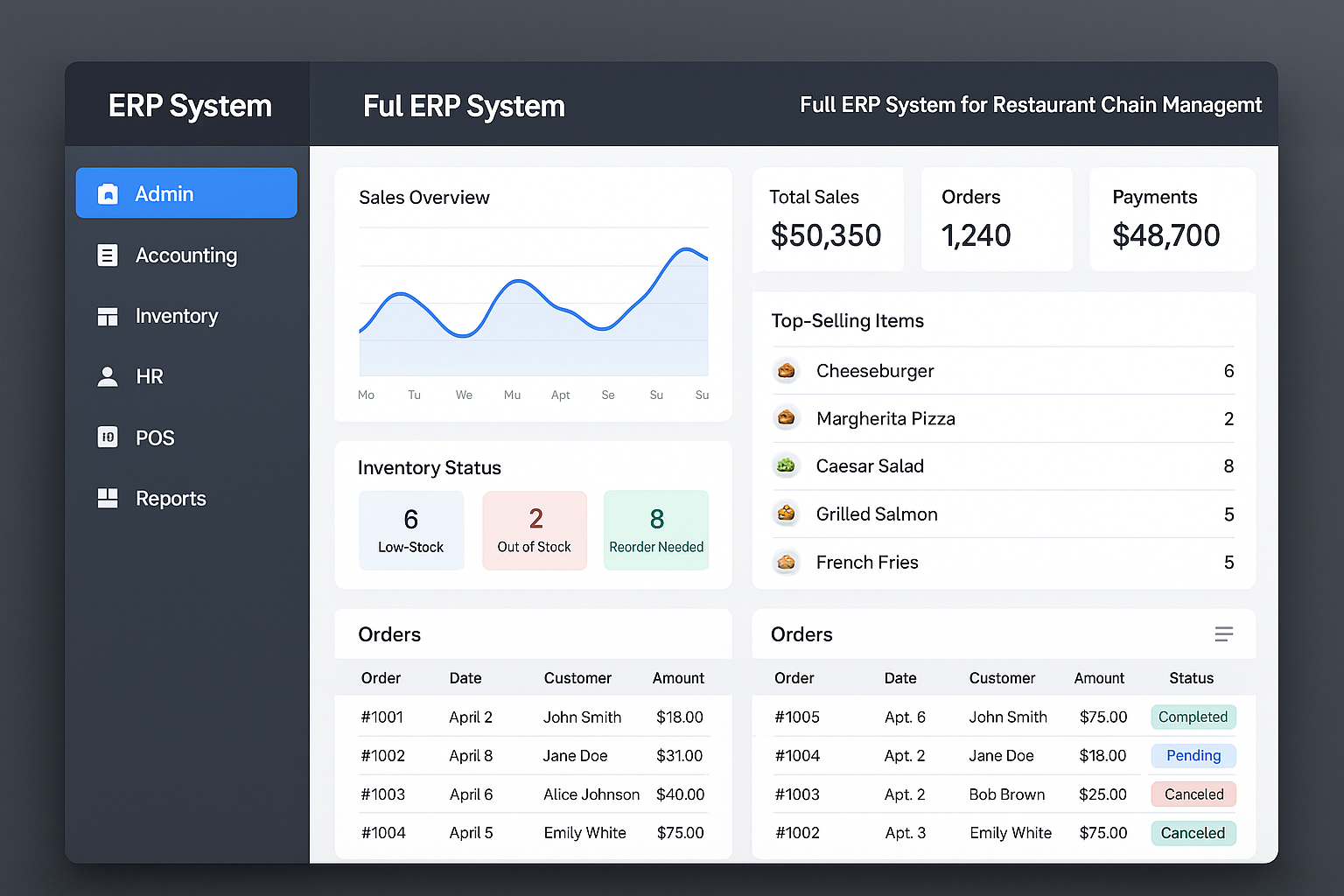
A large-scale ERP system designed to manage a full restaurant chain through a collection of integrated sub-systems, each handling a core operational area. The system provides complete control over financials, inventory, HR, point of sale operations, and administrative settings — all inside one unified web-based platform. Main Sub-Systems Included: 1) Admin System Manages global system settings. Handles user roles, permissions, and access control. Controls and monitors all integrated modules. 2) Accounting System Tracks all financial transactions. Manages expenses, revenues, and financial operations. Handles journal entries and closing balances. Provides full financial reporting. 3) Inventory System Manages items, stock levels, and warehouse operations. Tracks receiving, issuing, and transferring stock between branches. Monitors reorder levels and supplier purchases. 4) HR System Employee management and HR operations. Attendance and shift management. Salaries, deductions, and payroll workflows. 5) POS System (Point of Sale) — Major and critical part Complete cashier system for restaurant daily operations. Handles all types of orders (Dine-in, Take-Away, Delivery). Manages order details, payments, and receipts. Tracks daily revenues and cashier financial operations. Integrates with the inventory system for automatic stock deduction. End-of-day closing reports for each cashier. 6) Reporting System Financial reports. Sales and daily operations reports. Inventory and stock movement reports. HR and employee performance reports. The system was a large Web Dashboard with complex backend logic but without external APIs.
Tech Stack
Backend
Frontend
Database
Infrastructure & Tools
Architecture
Project Overview
The platform was built as a centralized management dashboard that allows administrators and staff to access different operational systems from a single interface. Each subsystem is responsible for a specific business domain while remaining fully integrated with the rest of the platform to ensure consistent data flow and operational efficiency.
The Admin System acts as the core management layer of the platform. It is responsible for configuring global system settings, managing users, defining roles and permissions, and controlling access levels for employees across all modules. This ensures secure access control and proper operational governance within the organization.
The Accounting System manages all financial activities within the restaurant chain. It tracks financial transactions such as revenues, expenses, and operational costs, while also handling journal entries, balance tracking, and financial reconciliation. The system generates detailed financial reports that provide management with insights into business performance and financial health.
The Inventory System handles all stock and warehouse operations across the restaurant branches. It manages items, monitors stock levels, tracks inventory movements such as receiving, issuing, and transferring stock between branches, and supports supplier purchase workflows. The system also tracks reorder levels to ensure that essential items are always available.
The HR System manages employee records and internal human resource operations. It includes attendance tracking, shift scheduling, salary management, payroll calculations, and deductions. This module helps streamline workforce management while maintaining accurate employee data and operational records.
The POS System (Point of Sale) is one of the most critical components of the platform and is used in daily restaurant operations. It allows cashiers to process customer orders including dine-in, take-away, and delivery orders. The system manages order details, processes payments, generates receipts, and records daily revenues. It also integrates directly with the inventory system to automatically deduct stock when orders are placed, ensuring real-time inventory accuracy. Additionally, the POS system provides end-of-day financial closing reports for each cashier.
To support operational analysis and business decision-making, the platform includes a comprehensive Reporting System. This system generates financial reports, sales and operational summaries, inventory movement reports, and HR performance analytics. These reports help management monitor business performance and make informed decisions.
Overall, the system functions as a complete enterprise-level ERP solution for restaurant chains, bringing together financial management, inventory control, workforce management, and point-of-sale operations within a single integrated dashboard. The project involved complex backend business logic and extensive module integration to support real-world restaurant operations, all implemented within a web-based administrative platform.
My Role: Back-End Developer
- Contributed to developing a large web-based ERP dashboard for a restaurant chain.
- Implemented backend logic across multiple sub-systems within the platform.
- Developed modules for inventory management (items, stock levels, receiving & issuing).
- Built HR modules including employee management, attendance, payroll, and deductions.
- Developed accounting features and daily financial workflows.
- Implemented POS workflows including order creation, payments, and cashier operations.
- Integrated POS operations with inventory to update stock automatically.
- Built modules for daily expenses, revenues, and cashier financial summaries.
- Implemented a complete user roles and permissions system.
- Developed reporting pages for sales, inventory, and financial operations.
- Optimized backend performance and ensured system stability.
- Collaborated with frontend developers for accurate data integration and UI flow.